

Rio massacre: The politics of extermination
Freedom News - Friday, November 7, 2025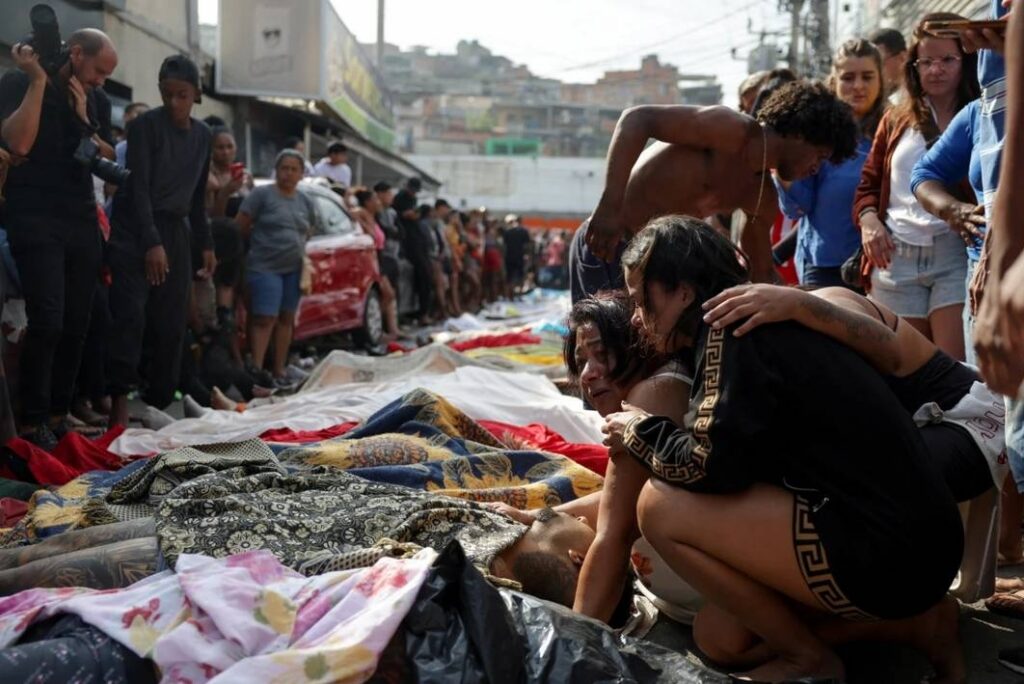
The ‘narcoterrorist’ is fabricated in place of an internal threat, capable of setting the city ablaze
~ Camila Jourdan, LASInTec ~
What threat should bodies displayed in public squares produce? What lesson of terror has always been expressed by public executions? Alongside this: what authorises the modern state to kill? How can death be produced and, at the same time, one claim to be doing so in defence of the democratic rule of law? How can a row of bodies be publicly displayed while simultaneously writing the caption: ‘city returns to normal after operation’? How can massacre and extermination be placed under the aegis of normality?
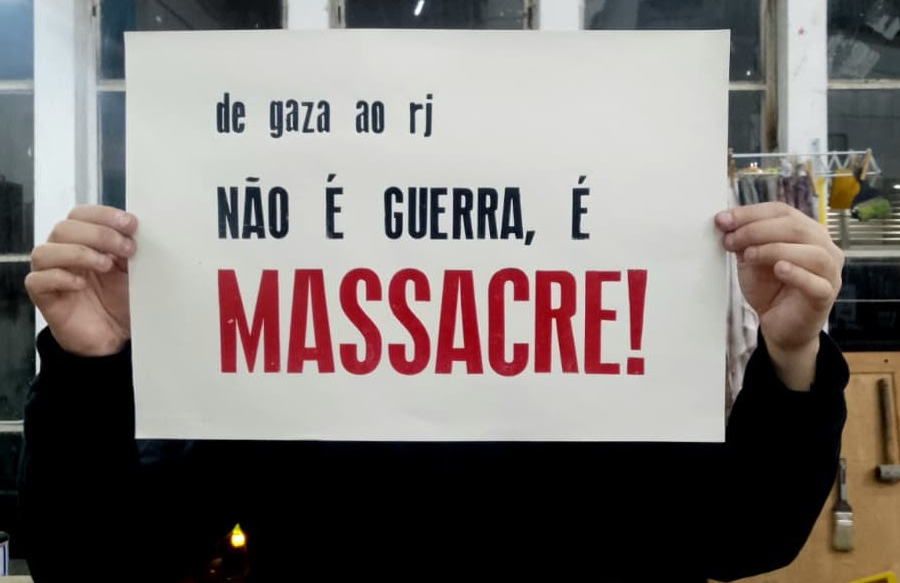
From the day of the operation, television insisted on saying that all the dead were ‘criminals,’ even if it wasn’t known who they were. Everything had been done to maintain order and social peace. Peace for whom, after all? The implication: ‘he died, therefore he was a drug dealer’ is old in this context of producing discourses of the supposed ‘war on drugs,’ and has been around for at least four decades. We know that the term ‘asymmetric warfare’ is used to avoid calling it a massacre, extermination, slaughter, persecution of the poor, crime management, and territorial control through fear.
When the media finally starts calling them ‘suspects,’ it’s always accompanied by depersonalsation. It’s important to make the targets non-subjects, and this is done in many ways. By displaying bodies in mountains. By placing numbers as the subject of the sentence. By attempting to avoid any empathy. More than 100 people were murdered, but this must be treated as a whole; only the family and friends of the four police officers are shown crying, feeling, demonstrating grief. The murdered people have no family, or this family is a hidden subject mentioned to acknowledge the guilt of the dead son; no one cares, they are just numbers: ‘128 dead’, ‘128 bodies’, no subjectivity… hence the backdrop for the governor’s statement, repeated by the security secretary: “we only had 4 victims in this operation, the police officers,” the others were contained, eliminated, shot down. The others are not people.
All this is then accompanied by the impossibility of defence; the animalised other is the place of the social enemy, and the social enemy is the one who can be eliminated without punishment. More than that, whose attempt at self-defence must always trigger their own death. The place occupied by those who are labelled as non-human is what the designation of ‘terrorist’ should produce, the place that people without rights should occupy. The interviews given by the governor and the secretary of security intransigently defend an illegal operation, supported by this discursive stratagem: the place where defence is impossible is also the place of the prey. That’s why it’s so important for them to say that what’s at stake is no longer the drug trade, but the defence of the state, that these are ultimately very dangerous ‘narcoterrorists’. The ‘narcoterrorist’ is killable par excellence, an enemy of civilisation, fabricated in place of an internal threat, capable of setting the city ablaze, paralysing the market, disrupting roads, bringing chaos. Against him, any violence is presented as perfectly legitimate.
Only in this way is it possible to justify leaving them in the woods for their families to retrieve the bodies. A refinement of cruelty, undoubtedly, but one that conveniently prevents forensic investigation. Because if they go to retrieve them, they are also accused of being criminals, of having tampered with the crime scene, of having generated any mark on the body that does not correspond to the version of the resistance report. But, if they were all in conflict, why weren’t their rifles found? Wouldn’t it be important for the police to leave evidence supporting their narrative at the scene, since they were acting in self-defense? How can unarmed bodies be seen as threats? Hence the importance of them being collected by their loved ones, those people who, even in the face of this sadistic strategy, insist on having empathy, like Antigone in the ancient myth.
[…] We shouldn’t claim that what happened was a tragedy, because it wasn’t; it was planned and executed according to plan. In this, the governor didn’t lie. In any case, Claudio Castro said that the police officers who died in the confrontation are heroes. I don’t want to dispute heroism. But if there is one action that can be applauded amidst all this, it is that of those who spent the night searching for the bodies of their relatives, friends, or even just neighbours in the middle of the woods. These people allow us to confront the fear that is systematically imposed on us as a policy of death.
Abridged machine translation
The post Rio massacre: The politics of extermination appeared first on Freedom News.