

Chiapas: Attacks on human rights defenders and journalists on the rise
Freedom News - Thursday, November 6, 2025
While last year the perpetrators were identified as being part of organised crime, in 2025 the main aggressors are unknown actors and state actors
~ Aldo Santiago, Avispa Midia ~
While the governor of Chiapas, Eduardo Ramírez Aguilar, boasts that it is the, “second safest state in the country,” attacks against human rights defenders, journalists, and activists have increased by 29% so far in 2025, according to a report prepared by the Observatory of Human Rights Defenders in Chiapas (OHRD)
Last Friday (31 October), OHRD released a report documenting 79 attacks against human rights activists and journalists that occurred in the southern Mexican state during the first half of 2025. According to the organisation, the data is alarming because, compared to the same period in 2024, it shows a clear upward trend in violence against human rights activists.
The records of the OHRD demonstrate that the documented types of attacks aim to obstruct or halt human rights activists’ work in Chiapas, as evidenced by the pattern of violence and harassment recorded. Among the documented cases, 85% were direct attacks on activists and journalists, and only 15% were related to contextual risks. Of all the violence, 62% were physical attacks and 38% were digital.
The most frequent types of aggression include intimidation, defamation, surveillance, criminalisation, verbal abuse and abuse of power. Digital attacks manifested as hateful, aggressive, intimidating, or sexually explicit messages.
“In particular, there has been an increase in surveillance and intimidation in digital spheres, as well as serious physical attacks. Defamation is carried out by state officials in retaliation for reports of violence and ineffectiveness by the state apparatus, criminalising the legitimate work of civil society and journalists,” the report details.
The Observatory of Social Security (Obse) also highlights the difference between the current data and the 2024 period regarding the origins of the attacks. Its records show a change in the profile of the aggressors during the first seven months of 2025. While last year the perpetrators were identified as being part of organised crime, in 2025 the main aggressors are unknown actors and state actors.
Secondly, the organization details that, especially in defamation cases, government authorities are identified as the perpetrators. Lastly, individuals linked to organised crime are identified. Among the main motivations attributed to the perpetrators are generating fear, discrediting individuals, undermining the work of the defence sector, criminalising dissent, and promoting self-censorship.
The most attacked areas: land, access to justice, and women
According to Obse, the 79 recorded incidents represent an average of 11 violent incidents per month. Among the attacks against human rights activists, the most frequently targeted rights are those related to land and territory, access to justice, and the rights of Indigenous peoples and women.
The defence of land and territory stands out as the area with the highest number of attacks, compared to the same period in 2024. The report also emphasises an increase in attacks against those who defend women’s rights.
Among the victims are members of human rights organisations, activists, community authorities, and leaders of local organisations in contexts of heightened violence. “The majority of documented victims of attacks are women, 66% in 2025, representing an increase compared to the same period in 2024, when they accounted for 58%,” Obse emphasises.
In March, during his report on the first 100 days of his term, Governor Ramírez Aguilar presented Chiapas as “the second safest state in the country.” However, information gathered by organisations collaborating with Obse reveals a very different scenario.
With the implementation of a new security strategy, which notably includes the actions of the new police force known as the Pakal Immediate Reaction Force (FRIP), communities have witnessed a reduction in armed confrontations, contributing to a perception of apparent calm, the report emphasises.
“However, to this day the violence continues and the forms of control and threats faced by the population persist, such as forced recruitment, enforced disappearances, forced displacement, and the presence of armed forces throughout the state,” Obse reports.
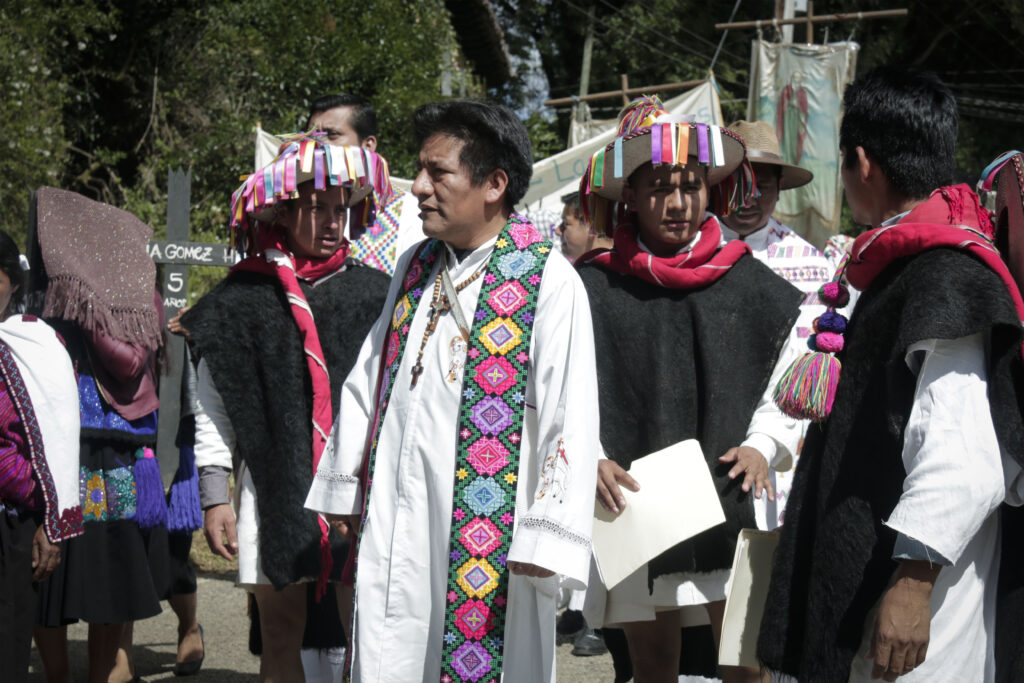 Slain activist priest Marcelo Perez
The report adds that FRIP operations have focused on prosecuting common crimes and, furthermore, human rights violations have been documented during police actions, including arbitrary arrests and torture. In addition, they emphasise that there is control over information and the narrative surrounding the security strategy, as exemplified by the numerous public denials by state officials regarding violent incidents reported by the population.
“With 73 human rights activists attacked from January to July 2025 and 69 during the same period in 2024, there is no progress in the safety of human rights defenders in the state,” says El Obse, for whom the persistence of the levels of violence contrasts with the institutional narrative that insists on the idea of a, “pacification” of the territories while normalising the security crisis.
“This narrative, however, is not based on data or a real transformation of security conditions, but rather on a strategy of increasing militarisation that reinforces territorial control without questioning—much less dismantling—organised crime networks,” the report states.
For these organisations, this contradiction is evident in the creation and strengthening of the FRIP, presented as a special force to combat organised crime, while at the same time, official discourse denies violence as a structural threat in Chiapas. “While it is claimed that ‘nothing is happening,’ police and military forces are deployed under the pretext of security, exacerbating the criminalisation of human rights defenders and the military occupation of Chiapas, with particular emphasis on border municipalities,” Obse emphasises.
Machine translation
The post Chiapas: Attacks on human rights defenders and journalists on the rise appeared first on Freedom News.