

Belgium: Mobilisation and strikes against far-right-led coalition
Freedom News - Thursday, November 27, 2025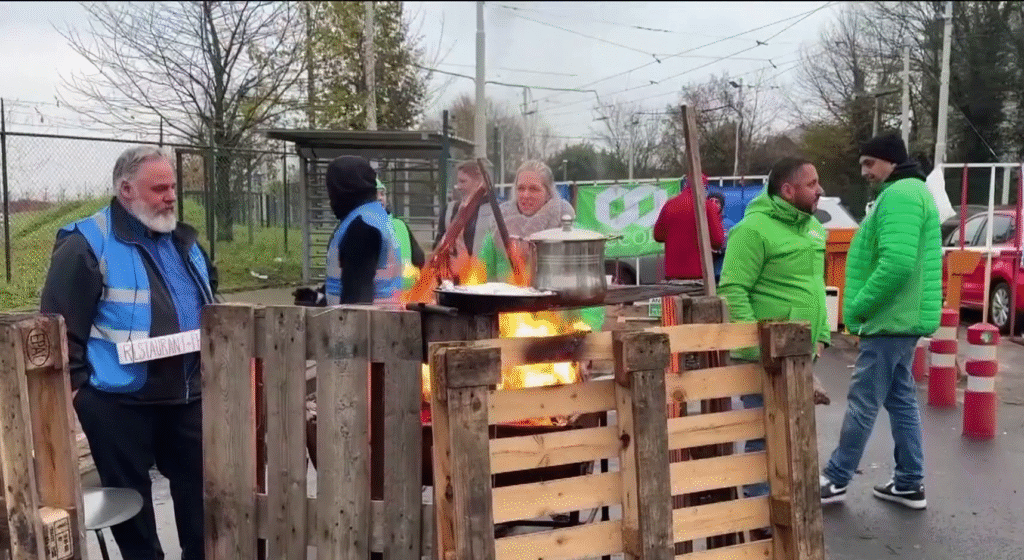
Large retail centres, roads, and waste management facilities were blockaded
~ from Rapports De Force ~
“For the past 10 months, this mobilisation has been steadily growing,” summarises Orville Pletschette, a trade unionist with the FGTB. From 24 to 26 November, the Belgian inter-union alliance (CSC Christian Democrats, FGTB Socialists, and CGSLB Liberals) organised three days of strikes against the reforms of the “Arizona government,” a coalition of parties ranging from the centre-left—including the Flemish Socialist Party—to the far right.
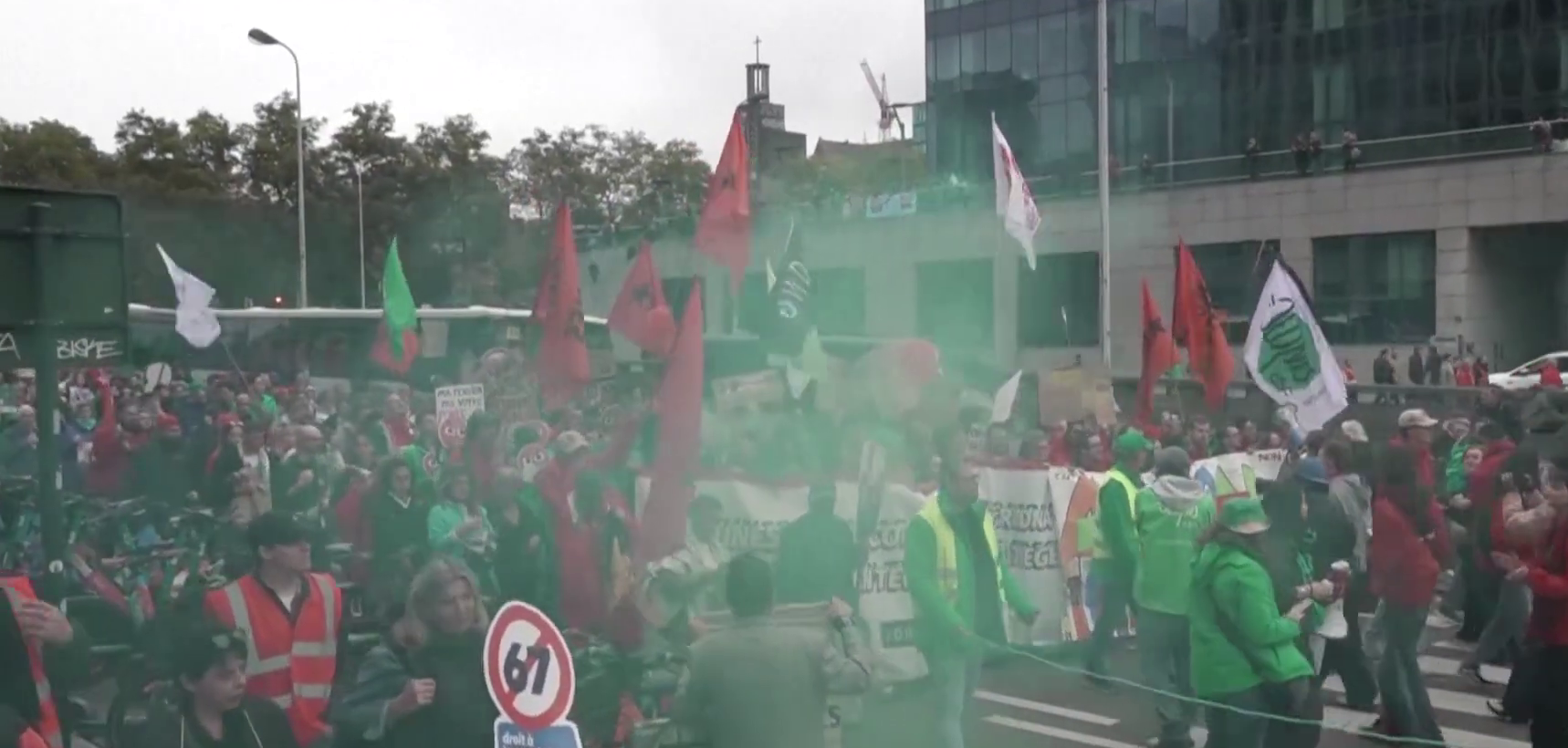
“The strategy was to implement rotating strikes: transport on Monday, the public sector on Tuesday, and the private sector on Wednesday. It’s one of the most ambitious plans the inter-union group can aim for. It shows a desire to further escalate the situation with the government as its target,” the union representative continued. After a particularly successful demonstration in October – 140,000 protesters in Brussels – the Belgian social movement is raising its voice to deliver a snub to Prime Minister Bart De Wever.
Three days of rotating strikes
November 26th was the high point of the mobilisation. In the morning, pickets, some of which were controlling access, were held in front of several companies in the port of Ghent. The “red” union, FGTB, also counted around forty such pickets in East Flanders, according to Belgian national news.
Large retail centres, roads, and waste management facilities were blockaded. In Enghien, teachers and their students formed a human chain of over 2,000 people. Postal services reported that four out of ten mail carriers were on strike, flights at airports were mostly grounded or severely disrupted, and public transportation, at the end of its three-day strike, remained disorganised for some time. “At the Université Libre de Bruxelles, we had three days of continuous blockades,” emphasised Orville Pletschette, a former student union member with the FGTB youth wing.
The two previous days were also marked by strikes. On November 25, there was significant mobilisation in municipal administrations, hospitals, administrative offices, and day care centres. On November 24, a railway and public transportation strike disrupted approximately half the trains on main lines, even fewer during rush hour. In Belgium, a minimum service law prevents traffic from being completely stopped, but these significant consequences for traffic indicate that the movement has been supported.
Ten Months of Mobilisation
The Belgian social movement did not reach such a level of conflict in just a few weeks. The mobilisation began more than ten months ago. It was a response to the government agreement reached between the members of the governing coalition. This agreement included a less favourable pension reform, an attack on unemployment benefits and the integration allowance, and also targeted the status of railway workers and casual workers.
The unions reacted quickly, and in February 2025, 100,000 demonstrators gathered for a major protest in Brussels. In March, an inter-professional strike was organised, and numerous regional and sectoral actions took place up until the summer.
The mobilisation resumed with even greater intensity in the autumn, with a demonstration that broke the February record and brought together 140,000 people in the streets of Brussels on October 14, according to the union count. Belgian police confirm this increase, announcing 80,000 demonstrators compared to 60,000 in February.
Pressure on the Governing Coalition
Since the beginning of the battle against the coalition, one of the social movement’s strategies has been to put pressure on the Flemish socialist party, Vooruit, a member of the governing coalition. On November 23, the coalition nearly collapsed, and after complicated discussions among the five member parties, an agreement outlining savings of €9.2 billion by 2029 was narrowly reached.
While the Belgian right wing wanted to challenge the automatic indexation of wages to inflation, a measure at the heart of Belgian social policy and a major achievement of the trade union movement, this measure will ultimately only apply to salaries above €4,000 gross per month. “The mobilisation has succeeded in demonstrating that there is no political majority in the country to pass these reforms,” Orville Pletschette continued.
Similarly, while the coalition hasn’t abandoned its reforms, it has postponed some of them. For example, the government has failed to make any progress on its pension reform. “This is mainly due to the fact that, unlike the issue of unemployment insurance, workers across all professional, regional, and political categories unanimously reject its proposal to raise the retirement age from sixty-five to sixty-seven,” explains union leader Daniel Kopp to Jacobin magazine.
Nevertheless, some reforms have been passed, such as limiting unemployment insurance to two years. The question of building a more assertive social movement has therefore been on the table for the past ten months.
With 1.5 million members in the FGTB, the same number in the CSC, and approximately 300,000 in the liberal CGSLB, Belgium boasts a unionisation rate of nearly 50%. While this rate is five times higher than many other European countries multi-day strikes remain difficult to organise. This led some union members, such as Mathieu Overhang of the FGTB, to campaign for longer strikes. This has now been achieved.
Machine translation
The post Belgium: Mobilisation and strikes against far-right-led coalition appeared first on Freedom News.