

COP30 farce in Lula’s Brazil
Freedom News - Wednesday, November 12, 2025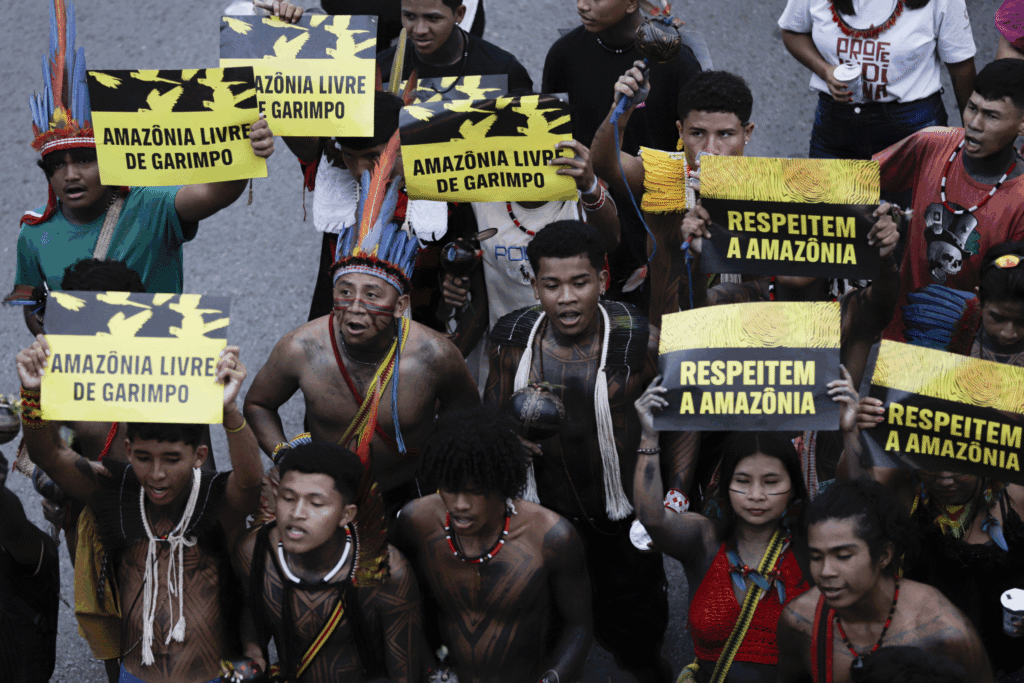
Their idea of ‘sustainable capitalism’ is to sell off the rainforest and build mega-projects
~ Rafael Sanz, desinformemonos ~
COP 30 has begun in Belém, the capital of the state of Pará and the main city in the Brazilian Amazon, a territory roughly the size of two Mexicos. The only reason it isn’t burning as it did in 2024 is that this is a La Niña year, meaning slightly more abundant rainfall in 2025. It will be the thirtieth time that lobbyists and representatives of governments and corporations from around the world gather to discuss fictions and unrealistic adjustments, green reforms for capitalism, and innocuous decarbonisation targets that they themselves routinely fail to meet, all while temperatures rise in the oceans, forests, and territories inhabited by humans. And in 2025, the various global climate representatives arrive in a rather complicated Brazil.
The first scene from this Brazil is the recent Penha-Alemã massacre in Rio de Janeiro, where at least 128 bodies were executed by the state in the open air and piled up in a public square. The bodies had barely cooled when the media were already repeating the chorus from the state government itself (responsible for the “operation”) that all the dead were members of the Comando Vermelho criminal faction. Whether they were or not remains unknown. What is known is that the police’s main targets, the drug kingpins, were neither victims nor arrested, the city was paralysed for days, and the affected communities were collectively punished for the presence of criminal groups there, both legal (128 corpses) and illegal.
But this approach to security is a constant throughout the country. In Rio, everything has been tried, from community policing models (Pacifying Police Units, UPPs) that have proven to be just as violent and prone to abuse as the regular police, to the infamous GLOs (Law and Order Guarantee Operations), in which the federal government authorises the use of the Armed Forces to assist the state police with public safety. In 2017, for example, General Walter Braga Netto led the GLO that promoted a military occupation of some Rio favelas, including Complexo do Alemão. A candidate for Bolsonaro’s vice presidency in 2022, he is now convicted of attempting a coup.
And so the model arrived in the Amazon thanks to COP 30. Last Monday (3 November), President Lula signed a GLO for the capital of Pará at the request of Governor Helder Barbalho. On Tuesday morning, the military began arriving en masse with their land, water, and air vehicles.
Social movements fear the repression that such security measures could generate, especially at COP 30, where Brazil is attempting to greenwash its recent environmental decisions.
And by “recent” we don’t mean the tragedy we experienced under Bolsonaro’s government, prior to Lula’s current third term, in which our biomes burned like never before due to the deliberate federal promotion of expanding agribusiness and mining frontiers. Given the previous disaster, the change in administration brought with it the mistaken idea that the Brazilian state would be an ally of the rest of humanity in the fight against the socio-environmental collapse we witness daily. It is not.
Throughout this administration, contrary to campaign promises to demarcate Indigenous and Quilombola territories and close the gap with extractive sectors (agribusiness, mining, hydroelectric projects, and highways), we have seen the opposite. Delays and bureaucratic obstacles have hindered the protection of already demarcated Indigenous lands and the demarcation of new territories. The encroachment of agribusiness into natural areas, culminating in the Day of Fire in 2024, not to mention the frenzy to build highways, railways, and hydroelectric plants that will primarily serve to distribute the predatory agribusiness’s production and facilitate the mass arrival of foreign data centers, with their high energy consumption and low-quality jobs for the working class.
On the eve of COP 30, the energy transition model we are going to present to the world is based on the premise of treating hydroelectric power as “clean energy,” in contrast to thermoelectric and nuclear power plants abroad. But they fail to include deforestation in the equation, which is the main cause of carbon emissions here. Belo Monte, a hydroelectric dam built in Altamira (a municipality in Pará affected by the recent GLO), destroyed the once-lush Xingu River, turning it into a lake, but that’s not all. It also facilitated the arrival of a development model that doesn’t consider preserving the rainforest. The entire region has suffered deforestation and successive fires ever since.
The model under which hydroelectric plants are built requires the construction of roads and railways that cut through the forest. These roads are necessary to transport all the grain, timber, minerals, and electricity produced in the most remote corners of Brazil. This infrastructure will also serve the small towns that are beginning to grow as a result of this model, which places greater demands on the previously preserved local environment. Two current examples in the transportation sector illustrate this model: Ferrogrão and the reconstruction of the BR-319 highway .
Ferrogrão is a planned 933 km railway, starting in Sinop (in the state of Mato Grosso, a central area for soybean and corn production in Brazil’s Midwest region) and reaching the port of Miritituba. From there, the transported produce would travel down the Amazon River to the Caribbean Sea, then be shipped to California and China. This multi-billion dollar project offers no social or ecological benefits to Brazil beyond satisfying the immediate interests of agribusiness. On the contrary, it will cut through conservation areas like Jamanxim National Park and affect hundreds of Indigenous and peasant communities. But there are two aggravating factors: first, the mere mention by the federal government of building the railway has already stirred up the region’s land market, which operates in a gray area between legality and illegality, between speculation and displacement; The second aggravating factor is that the transport of agro-industrial production to China and California would be carried out through the Panama Canal, whose capacity for use is already compromised due to the climate crisis.
And every time a railway or road is built in a previously untouched or relatively undisturbed natural area, what is known as the “fishbone effect” occurs—precisely a consequence of the booming grey market for land. Observe a wooded area from above, as if from a satellite or drone. The main road is opened, the backbone of the “fish.” Gradually, with the land market in full swing (literally burning everything down), secondary roads are opened to provide access to the newly occupied areas. And so we see how the landscape transforms into something resembling a fishbone.
This is the main concern of serious environmentalists and the communities living in the region where the BR-319 highway, which would connect Manaus (capital of Amazonas) and Porto Velho (capital of Rondônia), is slated for reconstruction. The problem is that this area, following a herringbone pattern, would extend the arc of deforestation all the way to Manaus and open the way to still-preserved areas of the western and northern Brazilian Amazon. This would cause the collapse of Brazil’s most resilient Amazonian ecosystems. Brazilians would be the first to feel the effects, with their rainfall system completely destroyed. But the world would also see a slight increase in temperature, exacerbating the global climate crisis.
Another problem with the charade of the ecological transition is that it doesn’t address the quilombos (settlements of escaped slaves), indigenous lands, and conservation areas, instead focusing on parcelling out forests and promising their preservation through privatisation and maintaining the same logic of private property that has brought us to this point in history. Let’s remember that before capitalism, human societies were never a threat to life on the planet, only to themselves.
The illusion surrounding the utopia of reforming capitalism is completed with the final touch to this cake of ashes and fire: weeks before the start of COP 30, Ibama (the Brazilian Institute of the Environment, a federal agency) authorised Petrobras (the state-owned oil company) to investigate the feasibility of oil exploration at the mouth of the Amazon River. This is simply a highly turbulent oceanic zone, where a single spill could affect several neighbouring countries. An authorisation to investigate that will undoubtedly become an authorisation to exploit, given the direction of the political debate. But they want to sell us the idea that we are going to drill in a very complex area from an environmental impact standpoint, extract rivers of oil, and burn it so that, who knows, one day we can finally abandon fossil fuels. Perhaps when we are all dead.
And while we watch year after year the “climate representatives” celebrating their parties and discussing their fictions, temperatures continue to rise, forests continue to fall, and people continue to live and die in increasingly worse conditions. It is impossible to debate the climate issue without including capital and the state in the equation as a problem rather than a solution.
Image: Indigenous people from various regions protest during the free land camp in Brasilia, 4 October. Joédson Alves/Agência Brasil
The post COP30 farce in Lula’s Brazil appeared first on Freedom News.