

Keeping a community afloat
Freedom News - Wednesday, October 15, 2025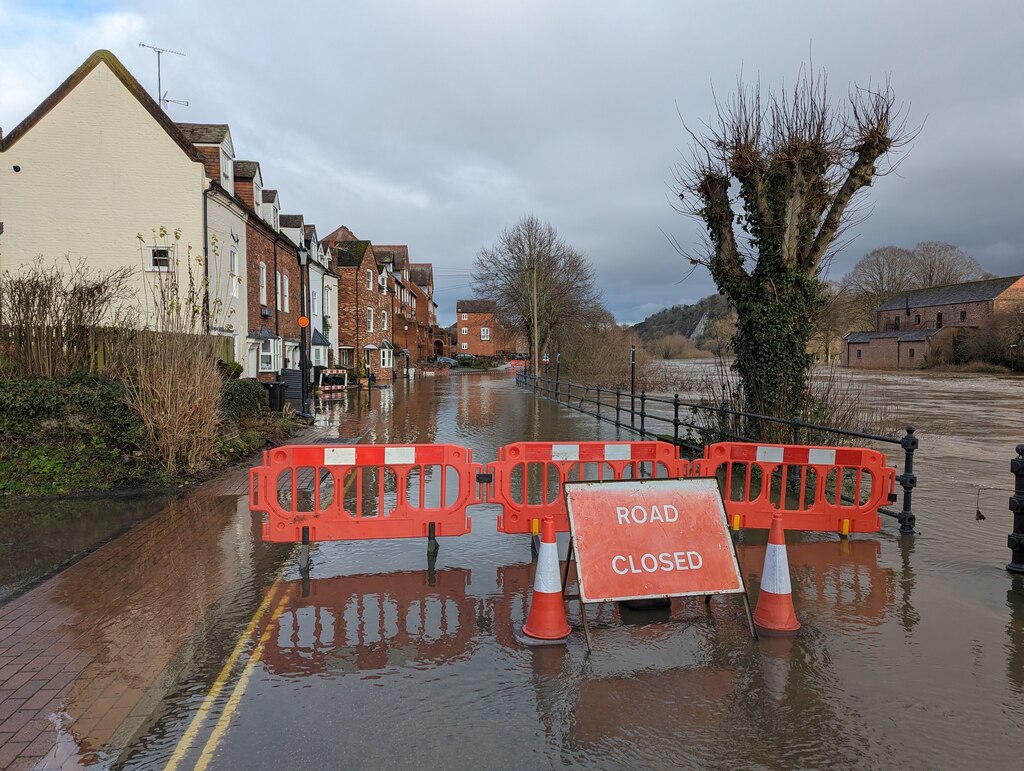
We need to completely rethink our cities’ relationship with water
~ Isaac Bell Holmstrom ~
Recent analysis shows that extreme flood likelihood across the UK is leading to insurance companies entirely withdrawing from at-risk areas, with certain locations being potentially abandoned. Working with the latest data from Aviva, the Guardian reports significant flood risks across the country, particularly in London, Manchester and the North East of England, drawing attention to the extreme costs required in adaptation, let alone mitigation.
Tenbury Wells, Worcestershire, is now unable to insure its public buildings, and even individual property protection is becoming precarious. First the insurers write off the area, then businesses will stop financing development. Would a local council fund the opening of a new hospital, or even repairs to the old one, if the town will be underwater in two years? Or will the logic of investment and return lead to the abandonment of the town, a sacrifice zone? Those tied to the land—people too poor to move or homeowners locked into mortgages while prices plummet—will be left behind.
Serious investment is needed to change the direction of urban growth, but as fields of new-build single-family homes seep out into the green belt, it is clear that the government wants to build, and to build outwards. To meet its goals of 300,000 units built annually, Westminster played around with the idea of officially mandating authorities to construct homes to specific quotas, despite reductions in central funding to local councils and a corresponding rise in bankruptcies. But with only five construction companies building roughly half of the national housing market, we won’t be seeing innovation reach commercial construction any time soon.
There are incredible research-driven sustainable construction materials available, specifically designed to mitigate flood risks, but producers are limited by expensive certifications and highly localised supply chains. Cash-strapped councils will be driven to choose cheap contractors that continue building in the current direction—always favouring hard infrastructure like underground water runoff tanks. Across the world, even the most progressive hard infrastructure flood defences are short-term solutions; in Venice, the MOSE, a controllable barrier that seals the lagoon entirely during the aqua alta, the high tide, is being utilised more and more frequently, and by 2050 will have to remain up permanently—with massive impacts for the local environment.
Hard infrastructure is inflexible, it has strict limits and is essentially worthless after those limits are passed. Moreover, such projects are typically far from the local community they are designed to protect. Your average person can’t build a runoff tank, can’t fix one, and probably doesn’t know where they are located. A certain “learned helplessness” sets in when residents feel no control over their built environment, when only highly specialised technicians can modify it or, crucially for this scenario, repair it.
The private sector won’t help us here. Commodity-based strategies, such as those suggested in the Guardian article—“installing flood doors, tiling floors or raising electric sockets at ground level”—are feasible only for some, and certainly not for the most vulnerable.
Instead, we need to take the neighbourhood or the city as a whole, and completely rethink its relationship with water. Sustainable drainage systems (SuDS) focus on maintaining as much water as possible at the surface level—in swales, ponds, and rain gardens—maximising soil infiltration to then permit efficient and rapid evapotranspiration. But remodelling the urban surface requires confrontations with the entire built environment, with streets and roads, public parks and private gardens, brownfield sites and all future construction work.
Working from the bottom up, building local power to decide on, implement, and maintain the green and blue spaces of a local community, is a step towards liberation. Depaving—collectively ripping up paving slabs—is the most visual symbol of the dismantling of the built status quo, but depends on a committed local base that can seriously take care of its environment. The private sector and the central government are unwilling to take this on, and local governments are unable to. Communal decisions on urban land use are the only way to survive the climate crisis.
Image by TCExplorer CC BY-SA 2.0
The post Keeping a community afloat appeared first on Freedom News.