

Lewes FC, a club in pursuit of equality
Freedom News - Tuesday, December 23, 2025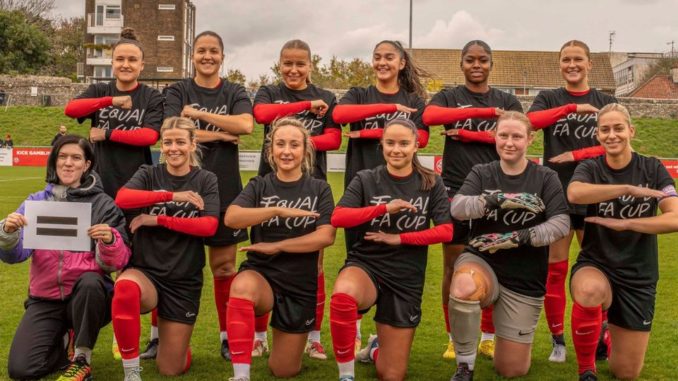
For several seasons, the club has been at the forefront of the fight for equal prize money for men’s and women’s competitions
~ from Dialectik Football ~
The Football Association has frozen prize money for the 2025/26 Women’s FA Cup while increasing the total prize money for the men’s competition. This represents a setback for the small steps taken in recent seasons towards equal prize money. Why has the Football Association (FA) chosen to exacerbate the inequalities in its flagship competition?
Lewes FC took advantage of the Women’s FA Cup third round to raise this issue again and request a meeting with the FA’s Professional Game Board (PGB) to get an explanation for this reversal. Ahead of their match against Crystal Palace at the Dripping Pan on 14 December, the East Sussex club called on its supporters to use the game as a platform to protest once more against the freeze on prize money for the Women’s Cup.
Rooks fans symbolically displayed banners bearing the equals sign in the stands. “Equality is not a cost, it’s a commitment to the future of football,” proclaims the campaign slogan. This demand is not new for Lewes, who launched the “Equal FA Cup” campaign in 2019. Since then, while the FA has indeed doubled the prize money for women’s competitions, the gap with that of men remains enormous.
The figures and the stark reality
To give an idea, the winning teams in the third round of the Women’s FA Cup received £35,000 in prize money, while the runners-up received only £9,000. Meanwhile, at the same stage of the competition, men’s teams will receive £121,500 for the winners and £26,500 for the eliminated team. The freeze on the overall prize money for the women’s FA Cup (144,000 pounds was added to cover a new preliminary round) is all the more unfair given that the men’s prize money has increased by 1.5 million pounds compared to the 2024/25 season.
The freeze also applies to prize money paid during the preliminary rounds of the men’s FA Cup, impacting dozens of amateur clubs already burdened by the overall increase in costs. Adding insult to injury, the winner of the men’s edition will receive 2.12 million pounds next May, 120,000 pounds more than last season. Considering the revenues of the Premier League clubs to whom the trophy is promised, this increase feels like an insult to the teams in the earlier rounds who could have shared it.
“Today, the lion’s share of the £23.5 million prize money for men’s football will go to wealthy Premier League clubs who arguably need it the least and for whom this money will make very little difference,” laments Ben Hall, director of Lewes FC, in an opinion piece published on the BBC website. “Same sport, same rules, same competition, same knockout format, same governing body, but a different value placed on the women’s and men’s players.” In the early rounds, the prize money is so paltry that many women’s teams lose money. The costs incurred by travel, medical coverage, and pitch rentals often exceed the prize money earned from a victory at this stage of the competition.

Inequality at every level
Ironically, the FA knows how to be egalitarian when it comes to national teams, its crown jewels. Since 2020, the FA has been paying women the same match fees and bonuses as men. “The question, therefore, isn’t whether the FA believes in equality, but rather why this conviction stops at the FA Cup,” Hall continues.
The governing bodies have no shortage of excuses, citing commercial realities and differences in television revenue. For Ben Hall, it’s primarily a matter of political choice: “The FA decides the prize money for both competitions. They could make them equal tomorrow; they simply would have to.”
For many, this situation is merely the result of the setback women’s football has suffered due to its 50-year ban by the English Football Association, perpetuating a view of football primarily as a male preserve. Under the guise of profitability, the FA is simply perpetuating this history of male dominance.
A call to other clubs
This is why Lewes FC wrote to all the teams participating in the Women’s FA Cup, inviting them to carry out protest actions such as a team photo before kickoff, with the players forming an “=” sign with their arms, and a 21-second pause after kickoff, referencing 1921, the year the FA banned women’s football. Lewes FC and Corsham Town did this during the first round.
With its “Equality FC” campaign launched in 2017, Lewes has already become the first club – in the English professional and semi-professional landscape – to allocate equal resources to its women’s and men’s teams. It has made this fight for equal treatment in football a central element of its DNA as a “community-based” club. While it is still struggling to bring many other clubs on board, the club is not giving up.
However, it is not entirely alone. A few seasons ago, Clapton CFC and Stourbridge FC Ladies also took up the cause.
Machine translation
The post Lewes FC, a club in pursuit of equality appeared first on Freedom News.